

Last Monday, January 12, legislators convened for the second year of 161st Georgia General Assembly.
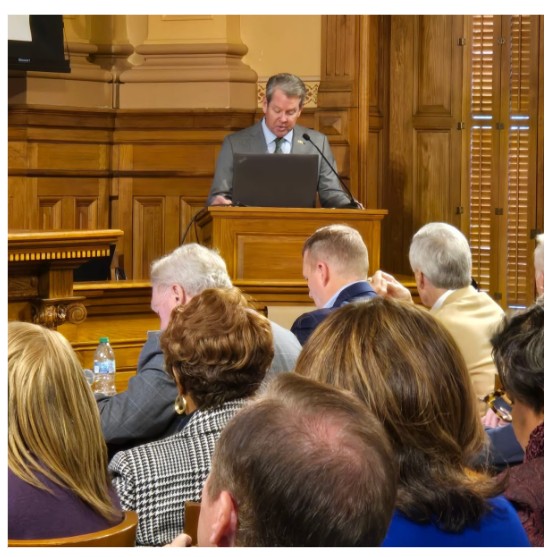
The highlight of the week was hearing Governor Brian Kemp’s (R) final State of the State address which included a preview of his budget priorities, including:
- Another $1 billion tax rebate that, he said, “Will return or save the average filer $250 and a married couple up to $500.”
- A proposal of an additional, 20-basis point reduction in the state’s personal and corporate income tax rate, bringing it to 4.99 percent.
- A $325 million investment in the University System of Georgia’s DREAMS Scholarship program (the first need-based scholarship of its kind in Georgia history).
- $2.1 million for medical residency slots.
- An enhanced retirement plan for state law enforcement officers which provide a higher match to the 401(k) savings accounts of eligible public safety officers.
- Georgia’s version of Trey’s Law, which prohibits the misuse of nondisclosure agreements in civil settlements related to sexual abuse and trafficking.
- $1.8 billion for I-75 in Henry County, including for express lanes.
- $200 million to continue improvements along Georgia 316, or perhaps better known to readers as University Parkway.
- $250 million in funding for local road projects.
- $100 million to strengthen and improve bridges across rural parts of the state.
- $35 million to create a natural gas infrastructure improvement fund within the Georgia Environmental Finance Authority.
- $50 million to combat homelessness through a new Homelessness Response Grant.
- A $2,000 bonus to all state employees (including teachers and law enforcement).
Overall, Governor Kemp delivered a message very similar to the way he has led - nothing showy, but measured and deliberate. With a legislature full of aspirants for higher office, Kemp & his allies will look to be a steady hand throughout Georgia’s 40 day session into this spring’s primary season.
Watch Governor Kemp’s full address.
Read Governor Kemp’s full address.
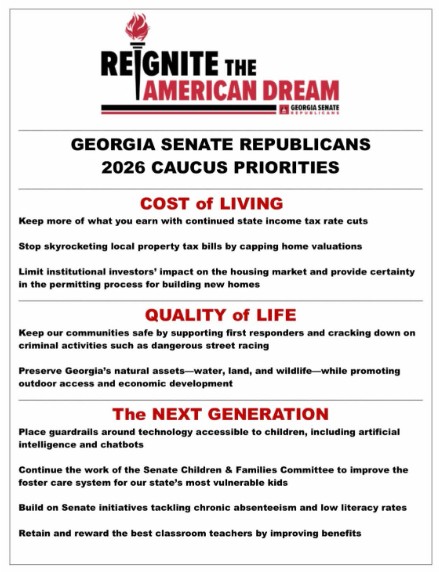
The Senate Republican Caucus also held a press conference announcing their 2026 Agenda (see below), called “Reigniting the American Dream,” with affordability issues at the core of the upper chamber’s priorities. Currently, eight members of the State Senate have announced intent to run for higher office. You can find the House Chamber and Speaker Jon Burns’ priorities on the link. And you can watch that press conference here.
Data Center Debate
The ever-evolving discussion on data centers in the Peach State added a few more wrinkles this week with the bipartisan introduction of bills that target the industry.
- HB 1012 is a bipartisan measure authored by gubernatorial candidate Rep. Ruwa Romman (D-Duluth) proposing a one-year moratorium on data center permits beginning on July 1, 2026.
- Another bipartisan measure is House Bill 528 sponsored by Rep. Debbie Buckner (D-Junction City), which seeks to require high-resource use facilities that are anticipated to have a peak energy load of at least 30 megawatts to provide a disclosure report to the Department of Revenue (DOR). The disclosure report for a planned high-resource use facility must be submitted no later than 30 days prior to entering into or renewing a contract for receiving a tax incentive or no later than 30 days prior to applying for any governmental permit, approval or license.
- Senate Bill 408 by Sen. Nan Orrock (D-Atlanta) & Lt. Governor candidate Sen. Greg Dolezal (R-Cumming) (also heavily supported by Senate Leadership) seeks to move the sunset date for tax incentives currently being given to data center developers to the beginning of 2027.
- Senate Bill 410 by Rules Chairman Matt Brass (R-Newnan) would outright end incentives for data centers if approved by Governor Kemp (Kemp vetoed a similar measure HB 1192 in 2024).
Both Senate Bills have been referred to the Finance Committee chaired by Sen. Chuck Hufsteler (R-Rome), who sponsored the still active SB 34 aimed at data centers last year.
Overall, there will likely be a data center measure passed this year, but its contents are yet-to-be determined as this issue matriculates through the legislative process.
“Little Budget” Week
Week of January 19 - 23
This week’s work will focus heavily on budget hearings, which will have an emphasis on “tightening the belt.” Governor Kemp and his Department heads will present their amended Fiscal Year 2025 budgets (Little Budget) to Joint Appropriations sub-committees. They will have FY 2026 (Big Budget) hearings later this session.


